Key Facts About Mental Health
Mental health is a critical part of overall well-being, yet many people underestimate how common mental health challenges are, and what actually classifies as a mental health challenge.
However, millions of individuals and families are affected each year, and increasing awareness is an important step toward reducing stigma and improving access to care.
The following statistics highlight the scale and impact of mental health conditions both in the United States and globally.
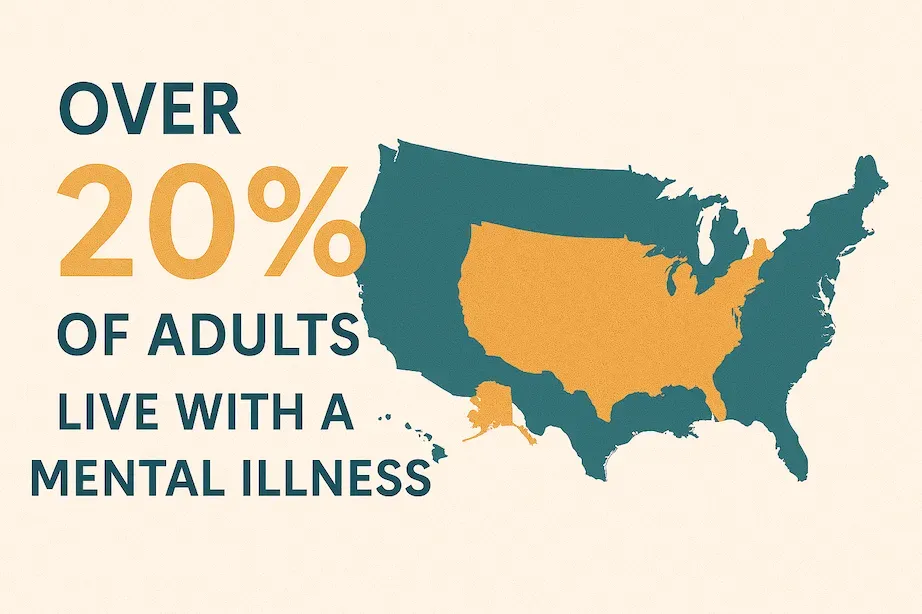
More than 1 in 5 U.S. adults experience a mental illness each year (60+ million people only in the United States). (National Institute of Mental Health, 2024)
Approximately 6% of U.S. adults experience a serious mental illness each year (15+ million people). (Key Substance Use and Mental Health Indicators in the United States, 2024)
Examples include schizophrenia, bipolar disorder, or major depressive disorder
More than 1 in 7 U.S. youth (ages 6-17) experience a mental health disorder each year (US National and State-Level Prevalence of Mental Health Disorders and Disparities of Mental Health Care Use in Children, 2019)
50% of all lifetime mental illness begins by age 14, and 75% by age 24 (Lifetime prevalence and age-of-onset distributions of DSM-IV disorders, 2005)
Annual treatment rates among U.S. adults with mental illness (Mental Health By the Numbers, 2025):
Non-Hispanic Asian: 32.5%
Non-Hispanic Black or African American: 38.5%
Hispanic or Latino: 44.1%
Non-Hispanic Two or More Races/Multiracial: 52.0%
Non-Hispanic White: 57.9%
Male:† 42.1%
Female:† 59.2%
Lesbian, Gay or Bisexual: 63.1%
Suicide is one of the leading causes of death in the United States (Suicide Data and Statistics, 2025)
More than 49,000 suicide deaths were recorded in the United States in 2023 alone
That is 1 life lost every 11 minutes
Suicide is the second leading cause of death among young people (ages 10-24)
12.8 million adults have seriously thought about suicide
The suicide rate in 2023 was four times higher in males than females
46% of people who die by suicide had a known mental health condition. That is 6 million people just in 2023. (Risk of Suicide, 2022)
More than 720,000 people globally die by suicide every year (Suicide - WHO, 2025)
Suicide does not just occur in high-income countries, but 73% of suicides occurred in low and middle-income countries in 2021.
Suicide is a serious public health problem that requires a public health response. With timely and often low-cost interventions, suicides can be prevented.
Only 38 countries report having a national suicide prevention strategy
I hope by now these statistics are more than just numbers to you. I hope that you can see that one life lost every 11 minutes is absurd, and we must do our part to bring change. Educating yourself and then educating your friends and family is an easy way to do this. Take a look at the following facts to see what happens when we don't do this.
The vast majority of people with mental illness are not violent (The Link Between Mental Illness and Firearm Violence: Implications for Social Policy and Clinical Practice, 2018)
They are 10 times more likely to be victims of violent crime than the general population.
Less than 5% of all violent acts in the U.S. are attributable to people with serious mental illness.
The media links mental illness and mass shootings together, and this has two effects. First, they promote stigma by conflating mental illness and violence, a bias that affects patients, providers, the public, and policymakers. Second, they distract the public and policymakers from dealing with the issues of violence and mental illness, and gun violence in particular, in an empirically grounded, frank way.
About 60% of adult males in the U.S. with a mental illness do not receive treatment in a given year, often due to: (Mental Illness - NIH, 2024)
Lack of knowledge to identify features of mental illnesses (Mental Illness Stigma, Help Seeking, and Public Health Programs, 2013)
Ignorance about how to access treatment
Prejudice against people who have mental illness
Expectation of discrimination against people diagnosed with mental illness
Lifetime prevalence of any mental disorder among adolescents is 49.5% (Mental Illness - NIH, 2024)
Some Statistics from the American Psychological Association (Survey: Americans Becoming More Open About Mental Health, 2019)
22% of adults (18-34) believe having a mental health disorder is something to be ashamed of
33% of individuals said people with mental health disorders scare them
39% would view someone differently if they knew that person had a mental health disorder
33% said they do not consider anxiety to be a mental illness, and 22% said the same about depression
23% of adults (18-34) do not think people with mental illnesses can live a normal life
35% of adults (18-34) believe that most mental health disorders do not require treatment
"More young adult respondents reported feeling shame and stigma surrounding mental health issues than their older peers," Arthur C. Evans Jr., PhD, APA CEO said. "This points to the need for psychology to continue to educate the public so that more people understand that there is no shame associated with being mentally ill."
I hope you can now see the need for education and awareness. These statistics could very well represent people in your life who feel the same way. This is why educating others and spreading awareness is the best thing that you can do for those suffering from a mental health condition. Also, take some time and check in on your friends and family and just listen for a bit, just allowing them to feel heard. Social support is crucial, as humans are social animals and we have not evolved to be in isolation all the time.
